



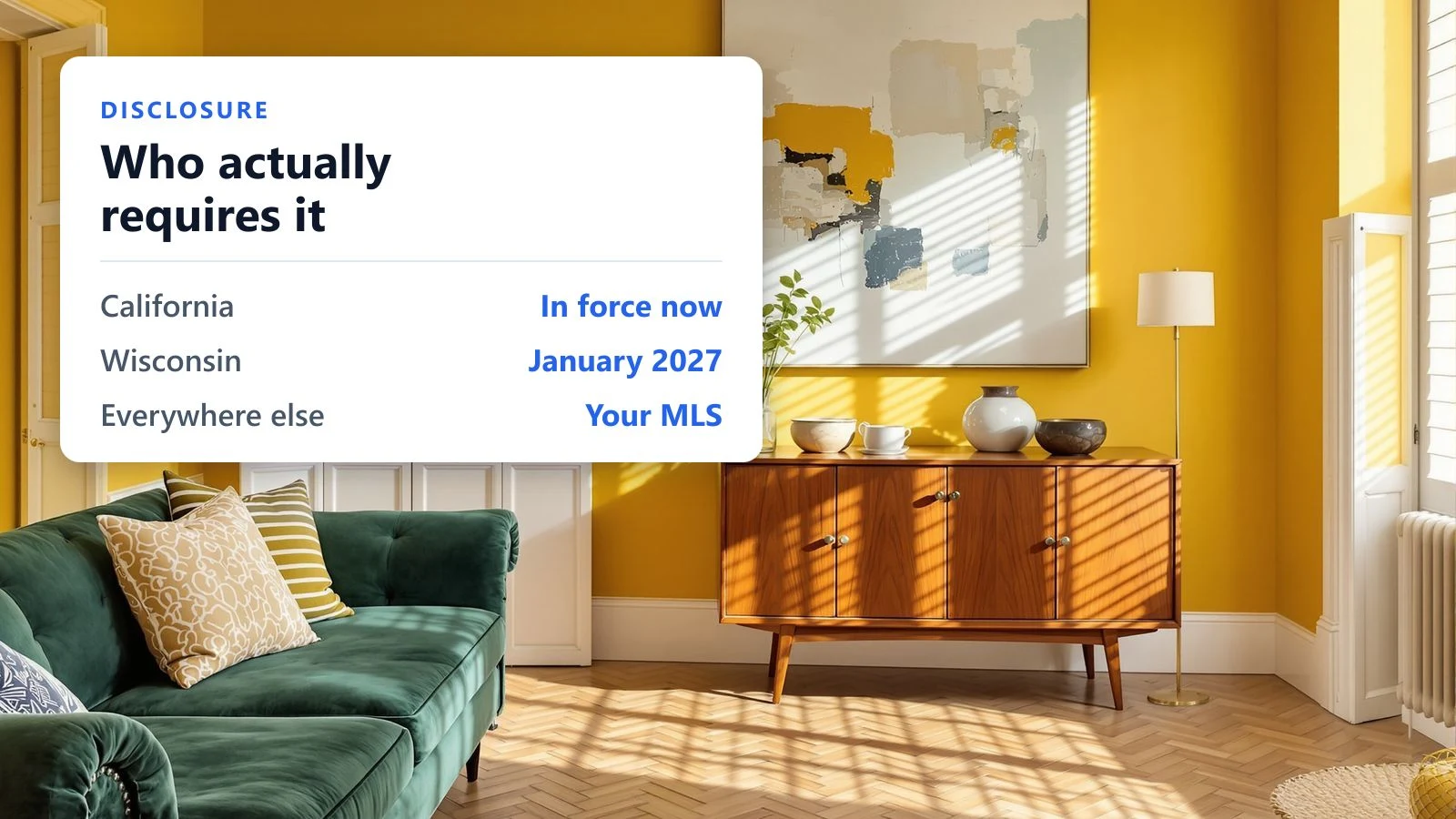
Ask whether you have to disclose a virtually staged photo and you will get two kinds of answer. Agents say “yes, always,” which is correct as advice. Vendor blogs say “laws are tightening across the country,” which is mostly not correct as fact. As of August 2026, exactly two states have a law specifically about digitally altered listing photographs, and only one of them is in force.
That is worth knowing precisely, because the two states ask for quite different things, and because the rule that will actually get you fined is, for almost every agent reading this, not a state law at all. It is your MLS.
This piece is the jurisdiction detail our earlier guide to virtual staging and the MLS deliberately left out. Everything below is quoted from the statute, rule or code section itself, with the sources listed at the end.
California: the strict one, and it is already live
Assembly Bill 723 was signed on October 10, 2025 and took effect on January 1, 2026, adding section 10140.8 to the Business and Professions Code. It is the most demanding rule on this subject anywhere in the United States, and the part most summaries leave out is the second half of the sentence:
“A real estate broker or salesperson, or person acting on their behalf, who includes a digitally altered image in an advertisement or other promotional material for the sale of real property shall include in the advertisement or promotional material a statement disclosing that the image has been altered and a link to a publicly accessible internet website, URL, or QR code that includes, and clearly identifies, the original, unaltered image. The statement shall be reasonably conspicuous and located on or adjacent to the image…”
So it is a two-part duty. Saying “virtually staged” is half of it. Being able to show the buyer the room as it actually is, at a link, is the other half. Four details decide whether it applies to you:
- “Digitally altered” is defined very broadly. The statute reaches any image altered “through the use of photo editing software or artificial intelligence to add, remove, or change elements,” and then lists them: fixtures, furniture, appliances, flooring, walls, paint color, hardscape, landscape, facade, floor plans, and even things merely visible from the property such as streetlights, utility poles, views through windows and neighboring properties. Note remove. Digitally emptying a furnished room is squarely inside this definition, and a lot of people assume it is not.
- Ordinary photo editing is carved out. Subsection (b)(2) excludes images where “only lighting, sharpening, white balance, color correction, angle, straightening, cropping, exposure, or other common photo editing adjustments are made that do not change the representation of the real property.” Your photographer’s normal pass is not caught. The test is whether the edit changes what the property is.
- It binds licensees, not platforms. The duty runs to “a real estate broker or salesperson, or person acting on their behalf,” which picks up your photographer and your staging vendor. It does not make the MLS or the portal responsible. It is your name on it.
- Sales only. The section says “for the sale of real property,” so rental advertising is outside it as enacted. That gap is the subject of a bill currently moving through the legislature, covered below.
On penalties, be careful with what circulates online. There is no fine written into AB 723. A willful violation of the Real Estate Law is a misdemeanor under section 10185, carrying up to $10,000 or six months, but willfulness is doing real work in that sentence: a negligent failure to label is not that crime. The realistic exposure is licence discipline from the DRE, and a private misrepresentation claim from a buyer who feels tricked.
Wisconsin: the one almost nobody has noticed
Here is the part that is missing from every other article on this topic. Wisconsin has a virtual staging disclosure rule too. It was enacted on December 9, 2025 as 2025 Act 69, and it creates a new Wis. Stat. section 452.136(1m), headed “Advertising enhanced by technology”:
“A licensee shall in all advertising disclose if the advertising has been altered or modified using technology, including artificial intelligence, to add, remove, or change elements of the property, that creates a false or misleading impression of the property.”
It is easy to miss because it did not arrive as an AI bill. It rode inside an omnibus real estate practice act mostly concerned with buyer broker compensation and off-MLS listings, as one clause out of nine.
Two things matter about it. First, it does not take effect until January 1, 2027, so nothing changes in Wisconsin this year. Second, the trigger is much narrower than California’s. California requires disclosure whenever elements are added, removed or changed, full stop. Wisconsin requires it only where the alteration “creates a false or misleading impression of the property.” On the face of the text, honest, obvious virtual staging may not trigger it at all, and Wisconsin asks for no link to the original. The state’s real estate board has not yet published a conforming administrative rule, so how strictly that condition gets read is still open.
The other 48: a real duty, just not a specific one
No other state has a statute or regulation that names digitally altered or virtually staged listing photographs. This does not mean you are unregulated. It means the duty comes from the general advertising rule your commission has always had, and those are written broadly enough to cover a misleading photo without mentioning photos at all.
| State | Rule | What it says |
|---|---|---|
| Virginia | 18VAC135-20-190(B)(3) | Property information in advertising “must be consistent with the property condition” |
| Arizona | A.A.C. R4-28-502(C) | Shall not “misrepresent the facts or create misleading impressions”; the statute’s definition of advertising expressly names photographs |
| Florida | Rule 61J2-10.025(1) | No advertisement “shall be fraudulent, false, deceptive or misleading” |
| Illinois | 225 ILCS 454/20-20(9) | Prohibits “advertising that is inaccurate, misleading” |
| Washington | RCW 18.85.361(2) | Reaches “false statements, descriptions or promises” likely to induce reliance |
| Ohio | ORC 4735.18(A)(21) | Advertising “misleading or inaccurate in any material particular” |
| Minnesota | Minn. Stat. 82.81 subd. 12(a)(8) | May not “advertise in any manner that is misleading or inaccurate with respect to properties” |
| Texas | 22 TAC 535.155(d) | No ad that “misleads or is likely to deceive the public” or “tends to create a misleading impression” |
| New York | 19 NYCRR 175.25(c)(9) | Advertisements “shall include an honest and accurate description of the property” |
| North Carolina | G.S. 93A-6(a)(1) | Prohibits “any willful or negligent misrepresentation or any willful or negligent omission of material fact” |
Virginia’s is the closest textual fit in the country: “consistent with the property condition” describes the problem with an undisclosed staged photo exactly, without any interpretive stretch. Arizona is next, because its definition of advertising specifically names photographs.
Two states have gone further without making a rule. New York’s Department of State issued a Trend Alert in November 2025 warning buyers about AI generated and manipulated listing images, and the North Carolina Real Estate Commission used its January 2026 bulletin to remind licensees that “you are responsible for the representations made in the advertisement and should check for accuracy.” Both are guidance. Neither creates a labelling duty on its own, and neither should be cited as if it does.
While we are here, some things you will read elsewhere that are simply not true: Texas did not update its advertising rules in 2025 to cover altered images, no state requires a watermark on virtually staged photos, and the widely quoted “$250 fine” belongs to one California MLS and is not in any statute.
What NAR’s Code of Ethics actually says
If you are a REALTOR®, Article 12 applies to you: members “shall be honest and truthful in their real estate communications and shall present a true picture in their advertising, marketing, and other representations.” The clause that reaches images is Standard of Practice 12-10, which prohibits “manipulating… listing and other content in any way that produces a deceptive or misleading result” and, since a 2018 amendment, “otherwise misleading consumers, including use of misleading images.”
What is worth stating plainly, because a lot of writing implies otherwise: the words “virtual staging,” “virtually staged” and “digitally altered” appear nowhere in Article 12 or any of its Standards of Practice. There is no NAR virtual staging rule. There is a well drafted catch-all that a misleading staged photo would fall into. And the Code binds NAR members, enforced by local associations through ethics complaints, not by your state.
Your MLS is what actually bites
This is the practical centre of the whole subject. Outside California, and outside Wisconsin from 2027, the enforceable virtual staging rule in your market is a private contract you already signed. MLS rules are specific, they are enforced with real fines, and they do not agree with each other.
| MLS | Rule | What it requires |
|---|---|---|
| Stellar (FL) | Article 04.04 | “Virtually staged” in the photo description field, the virtually staged field checked, and the public remarks must open with “One or more photo(s) was virtually staged.” Virtual staging is banned outright on pre-construction and under-construction listings |
| Canopy (NC) | 1.18.1 | Disclosure must be “directly ON the image”; disclosure “ONLY in captions, agent remarks, or supplemental text is NOT acceptable” |
| CRMLS (CA) | 11.5.2 | Submit the original too, display it immediately after the altered image, and mark the altered one conspicuously as “altered,” “digitally altered” or “AI altered” |
| ARMLS (AZ) | 8.23 | An MLS watermark reading “[Digitally Altered]” on the photo, paired with the original unaltered image |
| Bright (Mid-Atlantic) | Images policy 4.E | Virtually staged photos “must be disclosed in the MLS”; adding or removing elements outside the owner’s control is prohibited |
| MRED (IL) | 6.2.3 | Disclosure required in the specified field; no editing in or out of elements the owner does not control |
Two things fall out of that table. The first is a trap for California agents specifically. CRMLS satisfies the “show the original” idea by making you display the original next to the altered one in the carousel. The statute instead wants a link, URL or QR code to it. Those are different mechanisms, so doing what your MLS asks does not automatically discharge section 10140.8 for the same photo on your own website, in a brochure or in a social post.
The second is that Canopy MLS, in a state with no statute at all, has the strictest formulation found anywhere: the disclosure has to be on the image itself, and a caption will not do. Meanwhile Stellar bans virtual staging on new construction while Bright and MRED expressly permit it. There is no national rule here to learn. There is only your rule book.
Does the FTC come into this?
On paper, yes. Section 5 of the FTC Act prohibits deceptive acts or practices, the Commission’s deception standard asks whether a representation is “likely to mislead the consumer acting reasonably in the circumstances,” and its policy statement is explicit that this extends to “the visual and aural imagery of advertisements.” An undisclosed staged photo fits that shape.
In practice, there is nothing there. No FTC enforcement action, consent order, guidance document or rulemaking addresses real estate listing photos or virtual staging. It is an unapplied general standard, and anyone telling you the FTC “requires” virtual staging disclosure is describing a rule that has never been used. Your exposure is state licence discipline, MLS fines and private claims, in that order.
What is coming next
Three bills are worth watching, none of which is law today:
- California AB 2025 extends the AB 723 duty from sales to rentals, closing the gap described above. It has passed the Assembly and is on the Senate’s third reading file, which makes it the most likely of the three to pass.
- New York S9584 and its Assembly twin A11403 would require a clear and conspicuous disclosure on materially altered listing images, with a specific clause for virtual staging. Both are still in committee.
- New Jersey A4728 would permit virtual staging with disclosure, ban using AI edits to disguise a flaw, require originals on request, and set fines of $500 for a first offence. It has been reported out of committee twice and sits in Assembly Appropriations. It has not passed either chamber, whatever a search result may tell you.
The direction of travel is clear enough. Every one of these bills asks for the same two things.
The two things every version of this rule wants
Strip the jurisdictions away and every rule above is some combination of: say that the image was altered, and be able to show the room as it really is. Since this is Stagify’s blog, here is how we handle each, and where we stop.
One: the label, burned into the photo
There is a checkbox in the staging panel called Label as virtually staged. Tick it and a small “Virtually staged” tag is rendered into the finished image itself. Several deliberate decisions sit behind it:
- It is in the pixels, not in a field. A caption you type into a portal stays in that portal. This travels with the file into an email, a PDF brochure, a text message, a buyer’s camera roll. That is precisely what Canopy’s on-image rule demands, and it is the only form of disclosure that survives a photo being screenshotted and forwarded.
- Four styles and a size slider. Dark capsule, light capsule, minimal, or a full-width banner across the foot of the frame, with a live preview rendered by the same code that renders your final image, so what you approve is what you get. There is a floor on the type size, because a disclosure nobody can read is not a disclosure.
- It is on every plan, including free. Not an upsell, not a Plus feature. A compliance control behind a paywall pushes exactly the wrong people into publishing unlabelled photos.
- Eleven languages, because the stamp is burned into pixels a seller may hand to a buyer who does not read English.
- The download and the stored copy cannot disagree. The label is applied once, before the image is saved to your gallery and before it is prepared for download, so the copy you re-download six months later carries it too.
Today that checkbox lives with the main staging tool. We are extending it to the other places renders come from, and until that lands, treat a render from the Exterior Studio, the AI Designer or the Masking Studio as unlabelled and disclose it yourself.
Two: the original, on a link
The other half is newer. Every render you keep in your gallery has a client share link, and that link now has an option: Include the before photo. Turn it on and the page your client opens carries a drag slider, so they can pull the staged room back and see the space as photographed. The same page carries a full disclosure sentence explaining that the furniture is a rendering and is not included in the sale.
It is off by default, per render, on every plan, and you can switch it off again. That default is deliberate: a before photo of somebody’s actual empty house is not something to publish on their behalf without being asked.
Now the honest part, because this is a legal article and overselling it would be its own kind of misrepresentation. We are not claiming this makes you compliant with AB 723. The statute asks for a link that “clearly identifies” the original, unaltered image, and our share page presents a before and after comparison rather than an identified archival original. The stored copy is also resized for the web rather than being your camera’s file. And the duty attaches to your advertisement, which is somewhere we have no control over. Keep your originals. If you are advertising in California, put the link or QR where the statute wants it, next to the image.
A checklist that works in every state
You do not need to track fifty rule books. Do these five things and you are clear of every rule quoted above, including the two that do not exist yet.
- Put the disclosure on the image itself. It satisfies the strictest MLS formulation and travels everywhere the photo goes.
- Put it in the listing remarks as well. Some MLSs specify the exact wording and where it goes; Stellar wants it as the first words of the public remarks. Check yours.
- Keep the originals, and be able to hand them over. Every current law, every pending bill and several MLS rules converge on this. It costs you a folder.
- Never edit to conceal. Adding a sofa is staging. Removing a crack, a power line or a water tower is misrepresentation, and that is the conduct that turns a photo into a licence complaint.
- Read your own MLS’s photo policy once. It is stricter than your state law, it is the thing that actually fines you, and it takes ten minutes.
Disclosure has never been the part that costs you the sale. Buyers understand that an empty room was furnished on a computer; what they object to is finding out later.
Sources & notes
- California AB 723 (Ch. 497, Stats. 2025), adding Bus. & Prof. Code § 10140.8, and AB 2025 (pending)
- Wisconsin 2025 Act 69, creating Wis. Stat. § 452.136(1m), effective January 1, 2027
- NAR Code of Ethics and Standards of Practice (2026), Article 12 and SOP 12-10
- New York Department of State Trend Alert on AI-generated listings (November 13, 2025) and NCREC eBulletin on artificial intelligence (January 2026)
- FTC Policy Statement on Deception (1983)
- MLS rules are quoted from each MLS’s own published rule book or policy document: Stellar Rules and Regulations Article 04.04, Canopy MLS 1.18.1, CRMLS 11.5.2, ARMLS 8.23, Bright MLS Policy on Images and Documents § 4.E, and MRED Rules § 6.2.3. Rule numbers and requirements change; the linked documents govern.
- State advertising rules in the table are cited to the current rule or statute in each state. None of them mentions virtual staging; they are general advertising and misrepresentation provisions that reach it.