
Look up what home staging costs and you get two answers that don’t seem like they can both be true. The National Association of Realtors puts the median at $1,500. The quote sitting in your inbox for an empty three-bedroom says $4,500, plus a monthly fee once the first month runs out. Both are accurate. They are describing different houses, and once you see why, most of the decision makes itself.
Why the median looks so low
NAR surveyed 1,266 agents for its 2025 Profile of Home Staging. Median spend when a staging service was used came out at $1,500. When the seller’s agent did the staging themselves, $500.
That second figure explains the first. The median covers every kind of staging, and most staging is not a truckload of rented furniture. It is an owner who still lives in the house, a stager who spends two hours telling them what to put in storage, and maybe a few rented accent pieces. Work like that lands somewhere between $1,000 and $3,000, and plenty of it lands lower.
An empty house is a different job. There is nothing to rearrange, so somebody has to rent a household of furniture, drive it over, place it, and come back for it later. Fixr puts empty-house staging at $4,000 to $6,000 against $1,000 to $3,000 occupied. Other cost guides quote $2,000 to $5,000 up front for what sounds like the same work. Most of that gap is geography. It tracks what a truck and two people cost in your metro.
The bill has four lines
Stagers tend to quote one number, which is how sellers end up surprised in month two. Ask for it itemized. There are four things in there.
- The consultation, $200 to $600. Someone walks the house and writes up what to move, remove, repaint and fix. Some stagers credit it back if you book the full job, some don’t. It is the only line worth buying on its own, for reasons that come up again at the end.
- Design and installation. The big one. Sourcing, delivery, placement, styling. On a vacant home this is the $2,000 to $6,000, and it usually includes the first 30 to 90 days of furniture rental. Ask which, because it sets the start date on line three.
- Monthly furniture rental, roughly $500 to $1,200 for a house, or $500 to $600 a room. The $50 to $70 a room you sometimes see quoted is for individual pieces, not a furnished room.
- De-staging and pickup. Sometimes inside the install price, sometimes a separate collection fee. Easy to skim past in a quote that leads with a monthly figure.
Two contract terms matter as much as the prices do. Most staging agreements carry a 30 to 90 day minimum, so a house that sells in week one still pays the minimum. And renewals are usually whole months rather than prorated: day 31 of a 30-day term costs a full month.
The line that grows while you wait
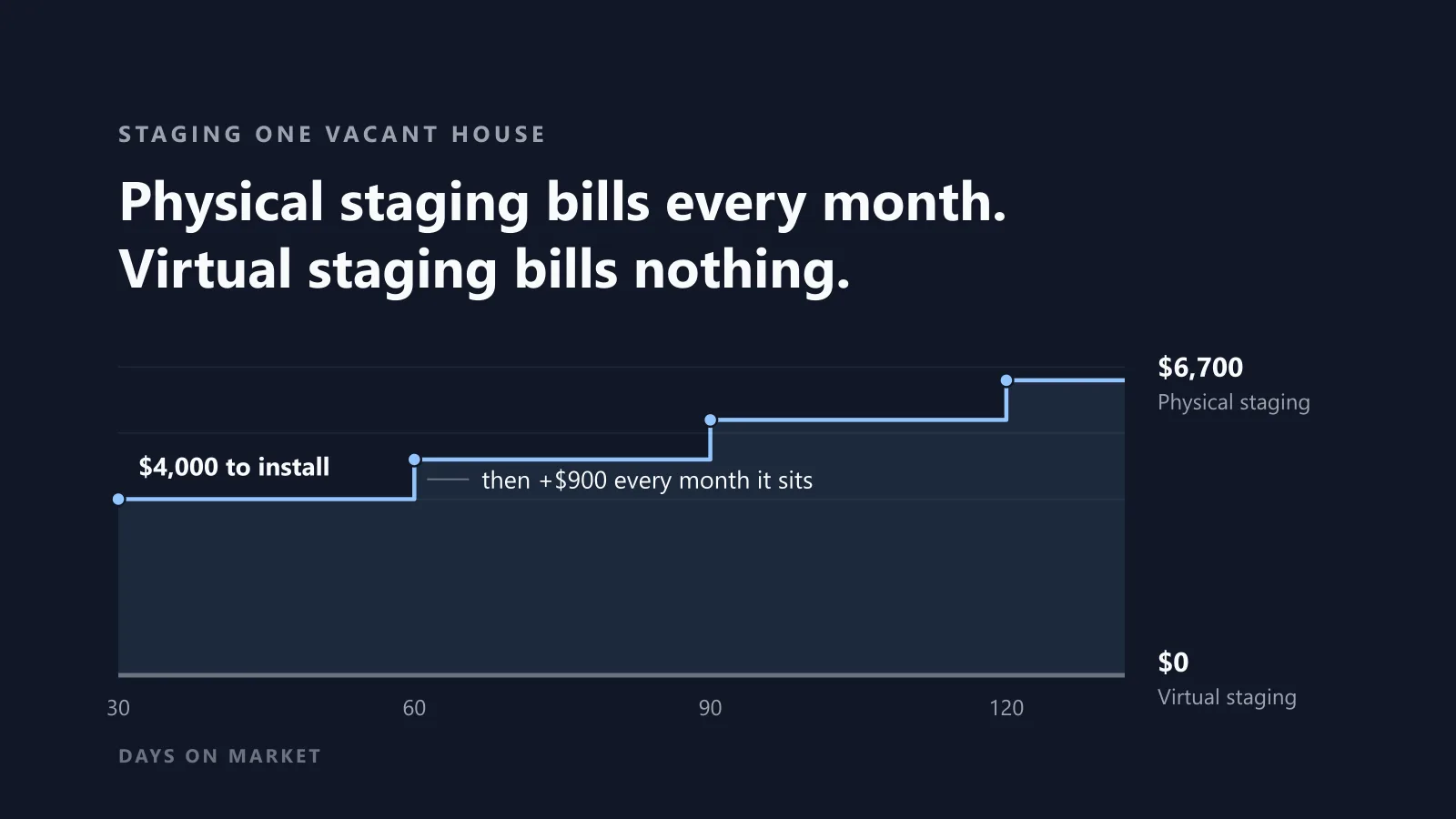
Ranges are hard to think with, so here is one house. Vacant three-bedroom, staged for $4,000 with the first 30 days included, $900 a month after that.
- Sells in 30 days: $4,000.
- Sells in 75 days: $5,800.
- Sells in 120 days: $6,700.
The install is fixed and the clock isn’t, which puts the risk in the opposite place from where most sellers expect it. Staging costs least on the house that was going to sell quickly anyway, and most on the slow listing you bought it for. Any staging budget quoted without asking how long comparable homes near you are sitting is half a number.
This is also why a price cut and a staging renewal so often land in the same week. By month three the question is not really whether to restage. It is whether you have a photography problem or a pricing problem, and staging cannot fix a price.
What the return data says, and what it doesn’t
The staging industry quotes NAR heavily. The figures are real, but they repay reading closely. From the 2025 report:
- 29% of agents said staging produced a 1% to 10% increase in the dollar value offered.
- 49% of sellers’ agents saw staging reduce time on market, 30% slightly and 19% significantly.
- 83% of buyers’ agents said staging made it easier for a buyer to picture living there.
Every one of those is an agent reporting an impression, out of a survey with a 2.5% response rate. None is a measured price difference between a staged and an unstaged version of the same house, which is not an experiment anyone can actually run. That doesn’t make the numbers useless, and 83% is a strong signal about how buyers behave that holds up year to year. It is a weaker kind of evidence than the “staging returns 5x” line you will see attached to NAR’s name, which NAR has never said. We went through that evidence in detail in Does Virtual Staging Actually Help Sell Homes?, including which claims fall apart when you chase the citation.
What the data supports is narrower: staging helps buyers visualize, probably shortens time on market, and produces a price bump that is real, modest and not guaranteed. On a $400,000 house, a 1% to 10% band runs from $4,000 to $40,000, which is the difference between not covering the staging bill and covering it ten times over. It is a range, not a return.
Where virtual staging changes the maths
Nearly everything expensive about physical staging is logistics. A truck, a warehouse, two people, and rent on a sofa. Virtual staging skips all of that and keeps the part most buyers ever see, which is the photographs.
Almost everyone who encounters your staging encounters it as a thumbnail on a phone. Physical staging pays for a full-size installation in three dimensions in order to produce about twenty photographs of it. When the photographs are the deliverable, that is a great deal of money for the step in between.
The prices aren’t close. Virtual staging services generally run $16 to $75 a photo, with some per-room pricing around $75 to $150; we compared the main ones in an honest 2026 comparison. Stagify is free at full resolution with no watermark. Stagify+ is $11.99 a month and adds the better model, furniture removal, multiple variations, the Masking Studio and the AI Designer. If staging is a step inside somebody else’s pipeline, the API is $0.15 an image.
So on that vacant three-bedroom the comparison is $4,000 to $6,700 against $0 to $12, and an afternoon against a week. At that spread, which one is cheaper stops being an interesting question. The useful question is what the $4,000 buys that the $12 doesn’t.
What the money still buys
Three things, and none of them are trivial.
The showing. Virtual staging furnishes the photos. The house is still empty when somebody walks through it. Empty rooms echo, they read smaller than they are, and the scuff on the floor becomes the only thing to look at. If your listing gets real foot traffic, that is the actual cost of going virtual, and it is why the best value is often the middle option: pay for the consultation, do the work it lists yourself, stage the photos virtually.
The high end. Above roughly $2M, buyers and their agents expect a physically staged house, showings are curated events, and the staging budget is a rounding error next to the commission. Don’t optimize this one.
The parts that aren’t furniture. Decluttering, depersonalizing, paint, and fixing whatever the consultation turned up. No virtual tool touches any of it, all of it shows up in the photographs, and it is the cheapest work anywhere on this page.
There is one more consideration that has nothing to do with money. Virtually staged listing photos generally have to be labelled as such: most MLSs require it, and in California it is now statute. That is a caption rather than a burden, but it isn’t optional, and the state-by-state rules are here.
A decision rule
Four questions, in order.
- Is the house occupied? Then you are in the $1,000 to $3,000 band and the median genuinely applies to you. Buy the consultation, do what it says, stage the photos virtually. Physical staging on an occupied home is mostly buying accessories.
- Vacant, and under about $750,000? Virtual staging plus a good photographer beats physical staging on cost by three orders of magnitude and on speed by a week. Put a fraction of the difference into the photography, since that is the input everything downstream depends on.
- Vacant, expensive, and getting showings? This is where physical staging earns its money. Get the four lines itemized and the minimum term in writing before you sign.
- Not built yet? Neither option works, and what you can honestly publish at each stage of construction is a separate question.
Whatever the answers, get the consultation. It is the cheapest line on the bill, it is the only one that tells you what is actually wrong with the house, and nothing stops you acting on the list yourself.
Sources & notes
- NAR: Report Reveals Home Staging Boosts Sale Prices and Reduces Time on Market (May 2025), reporting the 2025 Profile of Home Staging. The $1,500 and $500 medians, the 29%, 49% and 83% figures, and the survey details (1,266 usable responses collected February 2025, a 2.5% response rate) all come from this report.
- Fixr: Cost to Stage a Home, for the $4,000 to $6,000 empty versus $1,000 to $3,000 occupied split, the $200 to $500 consultation, and the per-piece furniture rental figures.
- Raleigh Realty: What Does House Staging Cost?, for the $2,000 to $5,000 vacant setup range, $500 to $1,200 monthly rental beyond 30 days, and the $300 to $600 consultation average.
- Per-photo virtual staging pricing ($16 to $75) is the sourced range from Stagify vs. Other Virtual Staging Tools, where the citations live, so it is not repeated here.
- All cost figures are US market ranges as of September 2026 and vary a lot by metro, home size and season. The worked example is arithmetic on typical quoted figures, not a quote. Stagify pricing is current at the time of writing; the plans page is authoritative.
- Disclosure requirements for virtually staged photographs are covered with citations in Do You Have to Disclose Virtual Staging?