



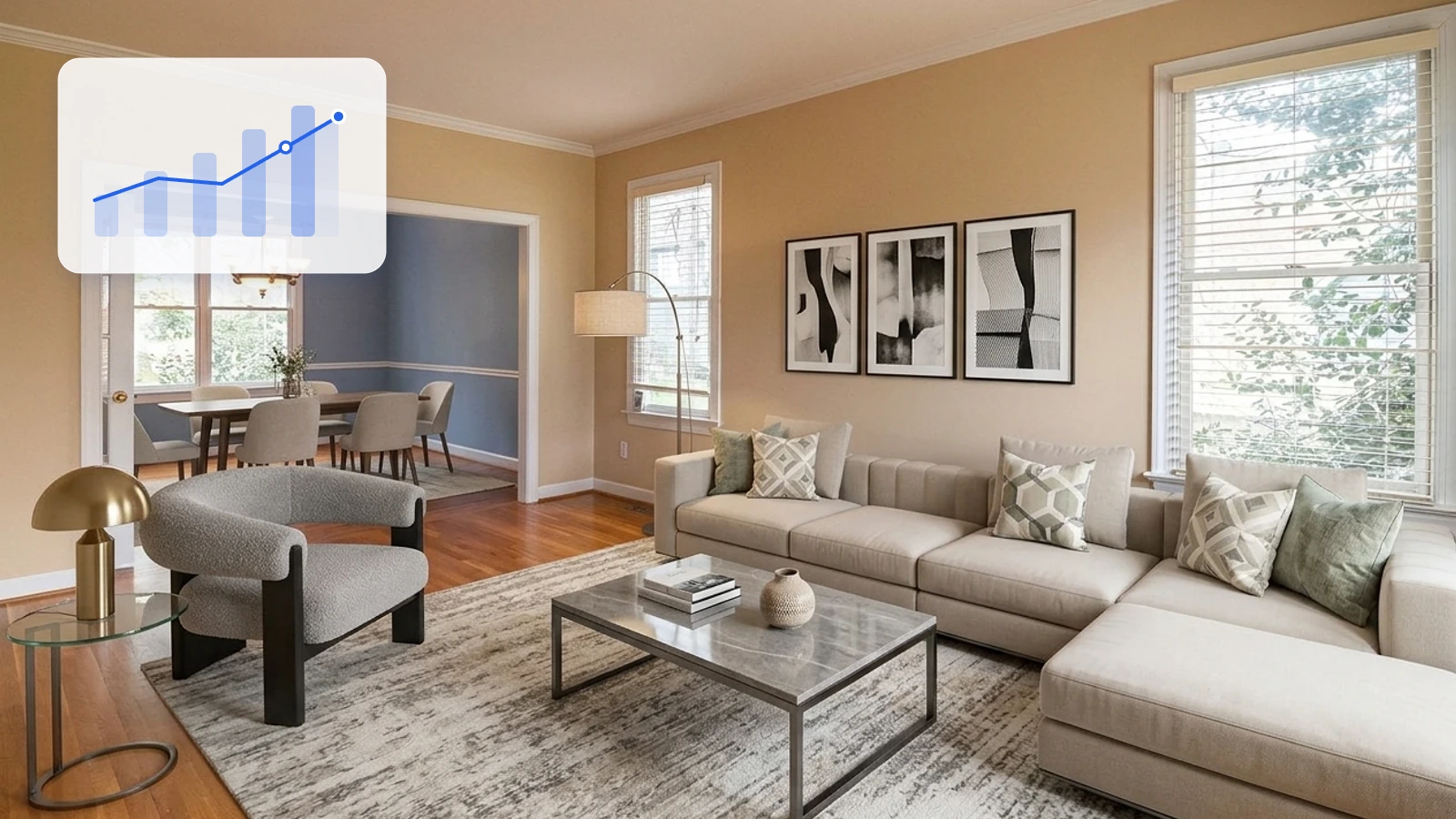
Short answer: the evidence for staging is strong, and virtual staging captures most of the same benefit for a fraction of the cost. Let’s look at what the data actually says, and be honest about what it does and doesn’t prove.
What the research shows about staging
The most credible numbers come from the National Association of Realtors’ Profile of Home Staging. In its 2025 report:
- 83% of buyers’ agents said staging a home made it easier for a buyer to envision the property as their future home.
- 49% of sellers’ agents said staging reduced the time a home spent on the market, with nearly one in five (19%) reporting a significant reduction.
- 29% of agents reported that staging pushed offers 1%–10% higher compared with similar, un-staged homes.
In plain terms: staging doesn’t guarantee a higher price, but a large share of the agents who work with buyers every day say it helps homes sell faster and makes buyers more willing to imagine living there, which is the whole game.
What about return on investment?
Staging isn’t free, so the real question is whether it pays for itself. Industry figures from the Real Estate Staging Association (RESA) put the return well into positive territory: staging ROI is frequently cited at several hundred percent, meaning sellers typically recoup far more than they spend. Traditional (physical) staging usually costs somewhere around 1%–3% of a home’s asking price, which is exactly why cost is the sticking point for most sellers.
Where virtual staging fits in
Here’s the honest part. Most rigorous data, including the NAR figures above, is about staging in general. Virtual staging is newer, and there’s less peer-reviewed research isolating it specifically. So we won’t pretend there’s a landmark study proving “virtual staging adds X% to your price.”
But look at why staging works: it helps buyers visualize the space (the 83% figure). That mechanism is exactly what virtual staging does, digitally. You get the same visualization benefit, and you get it:
- For a fraction of the cost. Physical staging runs into the thousands per home; virtual staging typically costs roughly $19–$99 per photo through most providers, and with Stagify you can start for free.
- In minutes, not weeks. No movers, rentals, or scheduling. Just upload a photo.
- For vacant or dated listings especially, where an empty or worn room is hardest for buyers to read.
Why it works: buyers shop with their eyes first
Nearly every buyer starts their search online, which means your listing photos are the real first showing. Empty rooms photograph smaller and colder than they are, and dated ones drag down the whole gallery. Staging, physical or virtual, gives each room a clear purpose and a reason to click, save, and book a showing. That’s the same reason agents have relied on staging for decades.
The catch: do it well, and disclose it
Virtual staging only helps if it’s realistic and honest. Overdone, fake-looking furniture can hurt more than it helps, and hiding a home’s real condition can cross into misrepresentation. The rule is simple: change furniture and decor, never the structure or condition of the room, and clearly disclose that photos are virtually staged. (We cover the specifics in Is Virtual Staging Allowed on the MLS?)
The bottom line
The data on staging is genuinely strong: it helps buyers connect with a home and tends to shorten time on market. Virtual staging delivers that same core benefit, buyer visualization, at a tiny fraction of the cost and effort. For most listings, that’s an easy trade to make.