



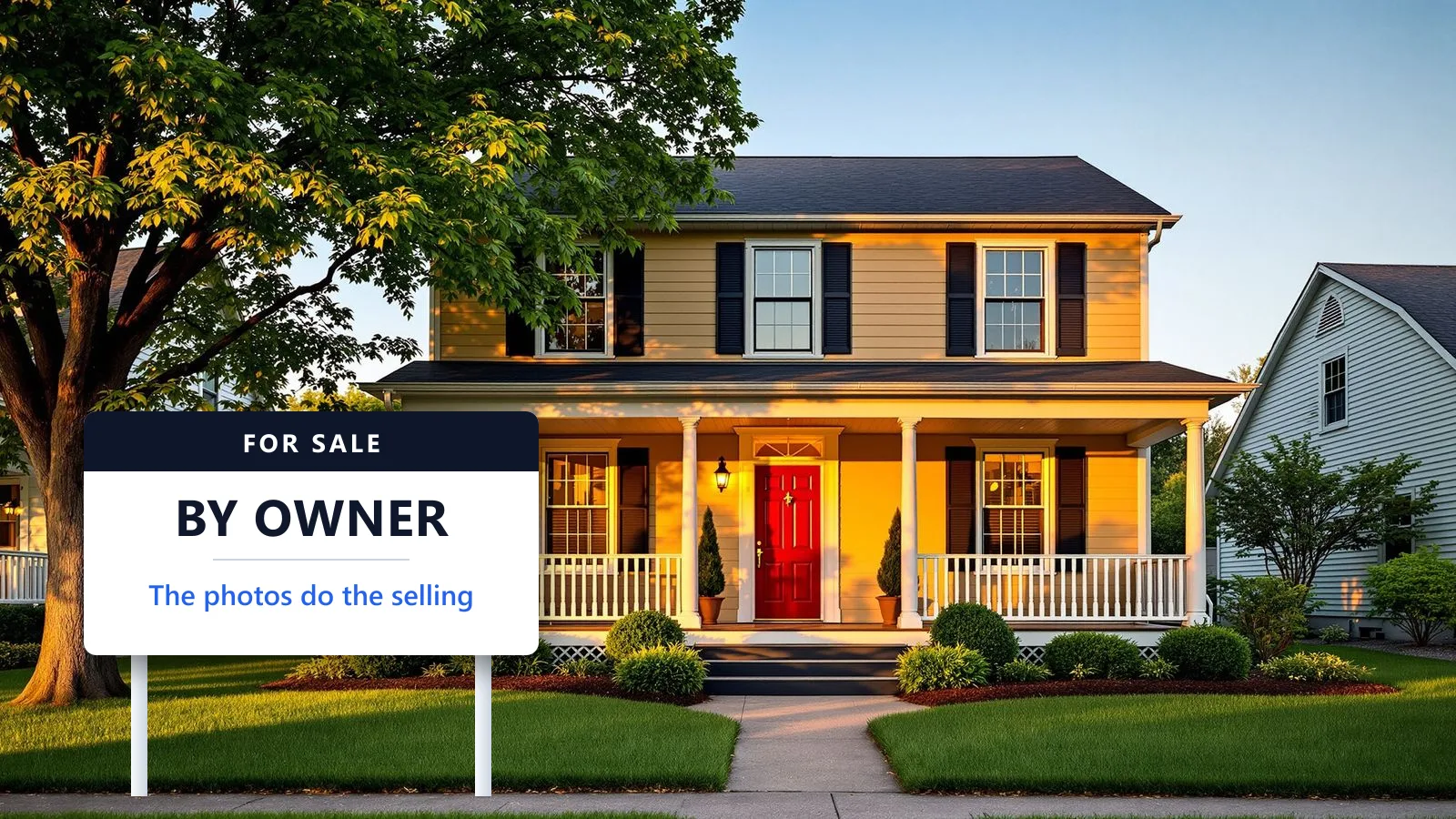
Selling your own house is now a genuinely unusual thing to do. In the National Association of Realtors’ most recent survey of buyers and sellers, for-sale-by-owner fell to 5% of all sales, an all-time low, while a record 91% of sellers used an agent. If you are reading this, you are in a very small group, and almost everything written for you is about one number: the commission you are keeping.
That is the wrong number to think about. Not because the commission is small, but because it is the part of this you have already solved. The parts you have not solved are the ones an agent was quietly doing, and the data is surprisingly specific about which one owner-sellers actually drop.
The $65,000 gap is weaker than it looks
You will meet this statistic within about ten minutes of researching FSBO, usually deployed to talk you out of it. In the same NAR survey, homes sold by owner had a median price of $360,000, against $425,000 for homes sold with an agent. Roughly an 18% gap. The implication offered is that hiring an agent adds $65,000 to your sale.
It does not, or at least this number is nowhere near strong enough to say so. Two things are going on inside it.
First, 60% of those FSBO sellers already knew their buyer. They sold to a friend, a neighbour, a relative, a tenant. Those are privately negotiated prices, often deliberately generous ones, and they were never exposed to the open market at all. That single fact accounts for most of what the gap is measuring: not worse selling, but different selling.
Second, the FSBO pool skews toward lower-priced housing to begin with, including rural properties and mobile homes, where the economics of paying a full commission never made much sense. You are comparing two different sets of houses and attributing the difference to the method.
So do not let the price gap frighten you. Let this one do it instead.
The number that should actually worry you
From the same research: 40% of for-sale-by-owner sellers did not actively market their homes. Not “marketed them badly”. Did not market them. And about one in five FSBO sellers eventually gave up and hired an agent to get the house sold.
That is the real story, and it is a much more useful one, because unlike the price gap it describes something you can simply choose not to do. When people say an agent “earns” the commission, the honest version is that the agent supplies a bundle: pricing judgement, a listing on the MLS, professional photography, distribution to the portals, the negotiation, and the paperwork. Take the agent away and most sellers successfully replace the paperwork and the negotiation, which feel like work, and silently drop the photography and the distribution, which feel like decoration.
They are not decoration. A buyer scrolling Zillow at eleven at night cannot tell whether your house is listed by an owner or by a brokerage. There is no badge. What they can tell, in under a second, is whether the first photo looks like a real listing or like a phone snap of a dim room. That single judgement decides whether your house gets opened or scrolled past, and it is made before anyone reads your price, your square footage, or the description you spent an evening writing.
When you sell your own house, the photos are not part of the listing. They are the listing. Everything else is what happens after somebody clicks.
The four photos that carry the listing
You will end up with fifteen or twenty photos. Four of them do most of the work, because they are the ones shown in the search grid and the first swipe of the gallery. Get these right and the rest can be merely competent.
- The front of the house. This is the thumbnail, the one photo every buyer sees whether or not they open your listing. Shoot it late afternoon with the sun behind you, from the far side of the street, straight on rather than at an angle, with the wheelie bins and the cars moved out of frame. We wrote a whole piece on why this photo pays back more than any renovation: curb appeal is the only photo every buyer sees.
- The main living space. The room that answers “could I live here”. Shoot from a corner, at eye level, with as much floor as you can get in the frame.
- The kitchen. Clear every surface completely. Not tidied: empty. The kettle, the knife block and the fruit bowl all read as clutter in a photograph even though they look normal in life.
- The primary bedroom. Buyers check it early to see whether the house is actually big enough for them.
Two things people get wrong on all four. Shoot in landscape, because every portal crops to a wide rectangle and a vertical photo gets butchered. And turn every light in the house on, including in the daytime, so the corners of the room do not fall into shadow.
Staging them for nothing
If your house is empty, or nearly so, you have the problem physical staging exists to fix and none of the budget. Empty rooms photograph badly in a way that is hard to argue with: they look smaller than they are, buyers cannot judge whether their own furniture fits, and a bare room reads as a question rather than an invitation.
Virtual staging is the free answer to that, and “free” is doing real work in that sentence, so here is exactly what our free plan includes:
- Unlimited free staging generations. No credit counter, so you can do every room and try each of them twice.
- No watermark, on any plan. The file you download is the file you publish.
- Full copyright. It is your photo of your house; the result is yours.
- Eight room types and eight furniture styles, plus a text box for anything specific, such as keeping the room bright or avoiding dark wood.
- About eight seconds per image.
What it does not include, so you are not surprised: removing furniture that is already in the room is a paid feature. The free plan furnishes an empty room rather than emptying a full one. If you are still living in the house, physically clear the surfaces before you shoot, and accept that your photos will show your furniture. If you have already moved out, free covers you completely. There is a fuller breakdown of where free tiers stop, ours included, in what “free” actually gets you.
The photograph matters more than the tool. Five rules, in order of how often people break them:
- Resist the ultra-wide lens. The single most common cause of AI staging that looks wrong. A very wide or fisheye frame bends the walls, and furniture placed into a bent room looks pasted in. Your phone’s standard lens beats its 0.5x every time.
- Include the floor. Furniture gets placed on the floor the model can see. Tilt down slightly rather than shooting the ceiling.
- Eye level. Roughly the height a person stands at, not chest height and definitely not from the doorway looking down.
- Flat, even daylight. Mid-morning, curtains open. Hard shadows and blown-out windows both remove detail the model needs.
- Stand in the corner. You are trying to show the shape of the room, not one wall of it.
Upload a JPG, PNG or WebP up to 25 MB. iPhone HEIC files are converted in your browser, so you can drag them straight in from your camera roll. A check runs on the photo first and will decline things that are not a property or a piece of furniture, which is mostly there to stop you spending a render on a screenshot by accident.
The disclosure rule works differently for you
Every MLS that allows virtually staged photos allows them on the condition that they are disclosed, and this is the point at which selling without an agent genuinely changes your obligations rather than just your workload.
Here is the part almost nobody explains to owner-sellers. The Realtor Code of Ethics, and its rule about truthful advertising, does not apply to you. You are not a Realtor and no broker is reviewing your advertisement before it goes out. That sounds like freedom. What it actually means is that the safety net which quietly catches an agent’s mistake is not there, while three things that do bind you remain fully in force:
- Your state’s rules on misrepresentation in a property sale. These apply to sellers, not just to licensees, and a photograph that misleads about the condition of the house is a problem regardless of who published it.
- California’s AB 723, if you are selling in California. Since January 1, 2026, a digitally altered listing image has to carry a statement that it was altered and a link, URL or QR code to the original, unaltered photo. Keep your originals.
- Your flat-fee MLS broker’s photo policy. If you paid a brokerage to enter your listing into the MLS, that brokerage is the member, and an MLS photo-rule violation lands on them. Read the rules they send you, because they will enforce them.
Practically, this is easy to comply with and easy to forget. There is a checkbox labelled Label as virtually staged in the staging panel; tick it and a small “Virtually staged” note is rendered into the image itself, so the disclosure travels with the file into an email or a text message rather than living in a portal field you filled in once. It is on the free plan, because a legal disclosure behind a paywall is a bad idea on its own terms. Then write the sentence into your listing description as well. The state-by-state detail, and what the MLSs actually require, is in our 2026 disclosure guide.
What is still worth paying for
Selling by owner is not the same as selling for free, and the sellers who do it well are usually the ones who spent money deliberately in three places.
- Getting onto the MLS. A flat-fee MLS service puts your listing in the same database agents use, which is what syndicates it to Zillow, Realtor.com and Redfin. Packages generally run from around $100 to a few hundred dollars depending on the state and what is bundled. This is the one expense that is close to non-negotiable, because the alternative is hoping buyers find a house that is not where buyers look.
- An attorney, if your state expects one. Around a dozen states require or customarily use an attorney at closing, and several more do in practice. Check yours before you assume you can handle the contract, and note that this is the area where surveyed FSBO sellers most often report having got something wrong.
- A pricing opinion you did not produce yourself. An appraisal, or a paid comparative market analysis. Overpricing is the most common FSBO failure and the hardest one to see from inside your own house, because you are valuing your memories along with the kitchen.
Notice what is not on that list. Photography and staging used to be the expensive middle of it, and that is the part that has genuinely changed: the photos you take yourself, on a phone, in good light, staged in the browser, are now good enough to compete in the same grid as a brokerage listing. The distribution and the legal work are what still cost money.
The bottom line
The commission is the thing you are thinking about, and it is the thing you have already dealt with by deciding to do this. The 40% who never market the house are the cautionary tale, and marketing, in the specific sense that matters to a buyer at eleven at night, means four good photographs of rooms that look like somebody could live in them.
That part costs an afternoon and no money. Do that part.
Sources & notes
- National Association of Realtors: “FSBOs Reach All-Time Low, More Sellers Rely on Agents” (November 11, 2025), reporting the 2025 Profile of Home Buyers and Sellers. Source of the 5% FSBO share, the 91% agent-assisted share, the $360,000 and $425,000 medians, the 40% who did not actively market, and the roughly one in five who later hired an agent.
- NAR Economists’ Outlook: “Top 10 Takeaways from NAR’s 2025 Profile of Home Buyers and Sellers”. Source of the finding that 60% of FSBO sellers knew the buyer of their home.
- California Legislature, AB 723: Real estate: digitally altered images: disclosure (adds Business and Professions Code § 10140.8).
- Flat-fee MLS package prices and attorney-closing requirements vary by state and change often; the figures above are general ranges rather than quotes, and both should be checked locally before you budget around them.
- Physical staging and per-photo virtual staging cost ranges are covered, with sources, in Stagify vs. Other Virtual Staging Tools rather than repeated here.