
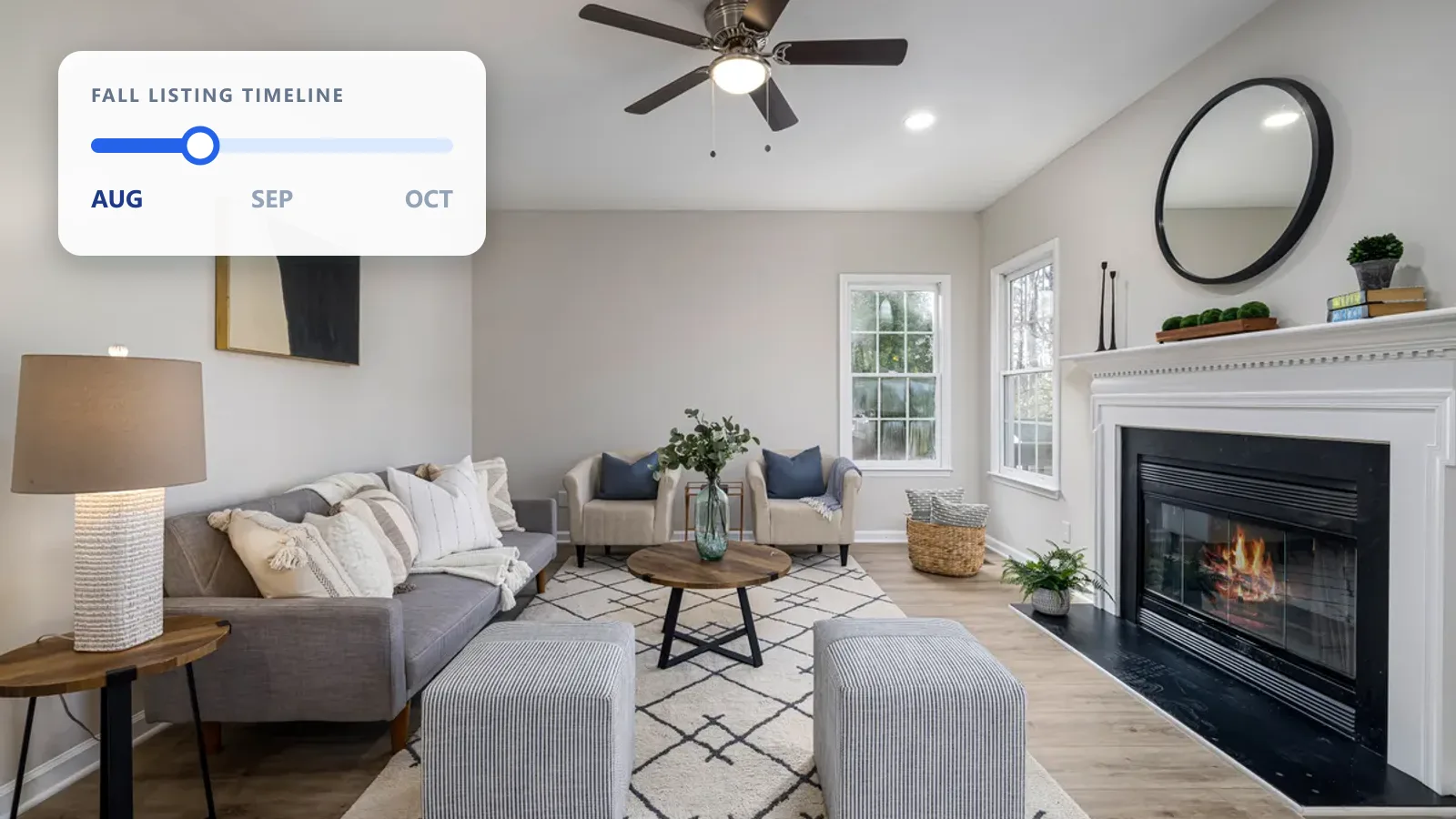
Most fall-market advice tells you that autumn is a hidden opportunity: fewer listings, more serious buyers. There’s something to that. But it isn’t what the sales data says, and starting from a comfortable premise is how sellers end up with a listing that goes live three weeks late and underdressed. Here’s the honest version, and the calendar that follows from it.
First, the uncomfortable part
Fall is the weakest stretch of the year to sell into. ATTOM’s April 2026 analysis of more than 52 million single-family home and condo sales from 2015 through 2025 found seller premiums (how much a sale beats the home’s estimated market value) peak in spring and bottom out in autumn:
| Month listed | Seller premium above estimated market value |
|---|---|
| March | 10.7% (the year’s peak) |
| April | 10.2% |
| May | 10.2% |
| September | 8.0% |
| October | 7.9% (the year’s low) |
That’s a spread of nearly three percentage points between the best month and the worst. On a $400,000 home, the gap between a March premium and an October one is roughly $11,000 of the same house.
This is not an argument against selling in fall. Plenty of people don’t get to pick: a job starts in October, a purchase closed, a lease ends, the estate has to settle. It’s an argument about margin for error. A spring listing can survive a mediocre debut because demand is doing some of the work. A fall listing can’t.
And buyers are not in a hurry
The seasonal pattern is landing on a market that was already slow. Redfin’s most recent national figures at the time of writing (May 2026) put the typical home at 49 median days on market, three days longer than a year earlier, with about 1.48 million homes for sale and the median sale price at $398,771, up 2.0% year over year. Modest price growth, more days sitting.
Work the calendar backwards from your list date
The reason “start in August” sounds early is that people count forward from today instead of backward from the list date. Counted backward, a mid-September listing is already a first-week-of-August project:
| Before list date | What has to happen | Why it takes that long |
|---|---|---|
| 6–8 weeks | Repairs, paint, anything involving a trade | Contractors book out, and this is the step that slips |
| 4–6 weeks | Declutter and pre-pack; yard and exterior work | Slow, unglamorous, and can’t be compressed by paying more |
| 3–4 weeks | Staging consult, quote, furniture selection, rental contract | Nothing is booked until the contract is signed |
| 2–3 weeks | Deep clean → staging install → photo day, in that order | Three separate appointments that have to line up |
| 1–2 weeks | Photo editing turnaround; listing copy; MLS input | Editing is a queue, and yours is not the only listing in it |
| List week | Go live; syndication propagates to the portals | Portal feeds refresh on their own schedule, not yours |
Lead times vary by market and by how busy your local trades and photographers are, so treat the table as a planning shape, not a promise. But the arithmetic holds: if you want to be live the week of September 14 and you’re doing this the standard way, the first phone call happens in early August.
Where the weeks actually go
Look at that calendar and you’ll notice most of the elapsed time sits in two line items.
Physical staging is the bigger one. It isn’t a single appointment: it’s a consult, a quote, furniture selection, a rental contract, a delivery window, an install day, and eventually a de-stage after the sale. It typically runs somewhere around 1–3% of the asking price, and it’s often billed monthly until the home sells, which is precisely the wrong billing model for a season where homes sit longer.
Photography is the other. Booking a photographer who is good at rooms takes lead time, and the edit turnaround after the shoot is a queue you don’t control.
Everything else on the list (repairs, decluttering, cleaning, the yard) is real work, but it’s work you can start today and run in parallel. The two staging-and-photo steps are the ones that serialize, because each waits on the one before it.
What virtual staging takes off the calendar
This is the part that changes the shape of the schedule. Virtual staging deletes the consult, the quote, the rental contract, the delivery window, the install day, and the de-stage. What’s left is a photo and a few seconds.
- It runs on a photo you already have. No appointment to schedule, so it can’t collide with anything else on the calendar.
- It’s about eight seconds a room. The staging step stops being a week and becomes an afternoon.
- It’s reversible. Re-stage the same room in a different style as often as you like; nothing gets overwritten. That matters in fall, when a listing that sits may want a fresher look in week four.
- It’s free to start (unlimited generations, no card), so you can try three directions on the living room and pick, rather than committing to one furniture package sight-unseen.
What it doesn’t do: it won’t clean the house, fix the deck, cut the grass, or replace a photographer who knows how to light a room. Virtual staging compresses one step of the calendar very well. The rest of the list is still the rest of the list, and a bad source photo still produces a bad staged photo.
If you want the fuller argument for whether staging earns its keep at all, we went through the evidence in Does Virtual Staging Actually Help Sell Homes?
If you’re only staging a few rooms, stage these
Not every room is worth the same. In NAR’s 2025 Profile of Home Staging, buyers’ agents named the rooms that mattered most to their buyers:
- Living room: 37%
- Primary bedroom: 34%
- Kitchen: 23%
- Guest bedroom: 7%
That last number is the useful one. The guest bedroom is where to stop, not where to start. The same report found sellers’ agents most often staged the living room (91%), the primary bedroom (83%) and the dining room (69%), which lines up, with the exception that dining rooms get staged more often than buyers seem to care about.
Stage the three rooms buyers actually weigh, do them well, and stop.
Fall-specific things worth getting right
A few of these only matter in autumn, and they’re the ones people miss:
- Shoot earlier in the day than you think. Usable daylight collapses through October. A 4pm interior in mid-October is a materially different photograph from the same room at 4pm in July.
- Turn the lamps on. Warm interior light is the cheapest thing that reads as “cozy” in a fall photo, and it’s free.
- Don’t let the photos date themselves. Bright green lawns, pool floats, and patio umbrellas in a November listing tell every buyer the listing has been sitting since summer, even when it hasn’t. In a slow market, photos that look current are doing quiet work.
- Get the exterior shot before the leaves drop, if the timing allows. Bare branches are honest and fine; a lawn buried in leaves just looks unmaintained.
- Warm the palette. A room styled for summer (bare floors, cool greys, minimal textiles) can read cold in a November gallery. If you’re staging virtually, this costs you one extra render.
Disclose it
Non-negotiable, and it takes ten seconds: label virtually staged photos as virtually staged. The rule is simple: change furniture and decor, never the structure or the condition of the room. We covered how the rules work, and sample wording, in Is Virtual Staging Allowed on the MLS?
If you’re already late
Say it’s the third week of August and you need to be live in September. The compressed path, in order:
- Triage repairs: do the ones a buyer will see, defer the rest and price accordingly.
- Declutter and deep clean. This is the step people skip and it’s the one that can’t be faked.
- Book one photo day. One.
- Virtually stage the living room, the primary bedroom and the kitchen. Same afternoon.
- Write the copy, disclose the staging, go live.
That’s a two-week path instead of a six-week one, and the thing you gave up was the furniture rental, not the photographs, and not the clean.
The bottom line
Fall doesn’t reward sellers the way spring does; the ten-year data is clear about that. Which is exactly why a fall listing has to arrive finished rather than arrive early and get fixed later. The debut only happens once, and buyers who are taking 49 days to decide are in no rush to give you a second look.
The two longest poles in the schedule are staging and photography. One of them you can compress to an afternoon. Start the calendar in August, and September is a list date instead of a scramble.